You Need to Learn How to Flirt in Roleplay, Bro!
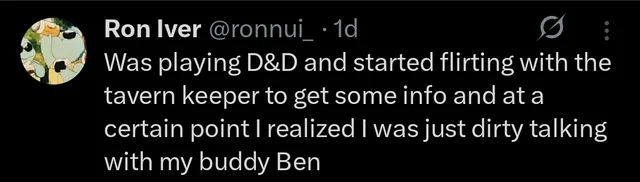
I think it's a recurring stereotype when a bard is a womanizer who dreams of flirting with every woman in the tavern. And that's cool and all, and for the longest time I thought when I had to play this kind of character, it would be natural for me. Others constantly praise me for essentially roleplaying a character that can flirt successfully, and I was confused at first. Mind you, I was also a nerd just like my friends, which means I don't really go out socially to drink, thus flirt or whatever. I've always had this formulaic approach (seeing that I'm autistic), but my friends keep asking me how to be a good flirt.
I think when trad games just hit you with "roll persuasion!", it removes this opportunity to exert your PCs to flirt with their own style. So, in this blog, I'll be writing my approach on how to roleplay flirting better! I'm hoping most of the tips can also work on roleplay in general. So you too can roleplay just like those angsty live TTRPG play sessions you see on TikTok or Instagram reels!
Pre-Flirting
I think that a lot of people (especially newcomers) assume that the alluring dynamic of the table is naturally formed after the characters create their group dynamic slowly and surely. It's like you're doing this unknown chemistry experiment and you're eager to see what the resulting compound is. And for some groups, that's totally fine! But, I think it would be better for us to actually establish a dynamic between our character and others.
I understand that you might be tempted to hide information regarding your character for the sake of future surprises and whatnot. But the thing is, this is not an actual life simulation. It's first and foremost a game, and we, the players, have a separate consciousness from our characters. I'd like to recommend players to initiate a conversation with your friends about what dynamic your characters have. If it isn't interesting, then do me a favor and tweak your character a bit until there's chemistry between y'all's characters. I've seen it happening many times, when characters in a party start feeling more like coworkers rather than a close, intimate squad of hooligans. You need to put extra care into crafting your character to make it feel fun not only to yourself, but for others. TTRPGs are fun because at the end of the day, it's a collaborative experience. You're not playing in a Character.AI chatbox and just expecting others to bend to your will. Inquire with your friends and discuss how to make your dynamic feel entertaining and fresh!
Table Etiquette
There's one thing that you should remind yourself: flirting is a two-way street, and you need to make sure your GMs or other players are comfortable. This is standard, but seriously, tell them that you plan to act flirty and make sure they are alright with that. Not a lot of people are interested in this type of exposition. Some prefer most of the time you can more of a comradery, or perhaps a good, genuine friend. Keep in mind what others desire and make sure that what you do doesn't overwhelm others. You can use fade to black in order to mask the ending of an interaction that isn't desirable to be narrated further.
Ultimately, make sure everyone feels comfortable, because flirting can be somewhat triggering or exhausting or many other things that other players may not find nice. Also remember that your character flirting doesn't have to be something that you can enjoy just for yourself. Keep flirting on downtimes instead of in the main plot itself. Always be aware of other players; if they're bored or not immersed, perhaps it's better to wrap up the flirting immediately and continue it some other time. There's always time to flirt, but there may not be enough time to save the world!
Establishing the Dynamic
How do you specifically make your dynamic fresh, you ask? Without, y'know, lore dropping about your characters too much? To preface, you can have this conversation at any point of your campaigns, not just at session 0. Your characters change, you yourself change, so be sure to update your friends if you wish to update your character's dynamic as well. But, moving forward with the initial question, I find it easier with this formula below:
Establish one thing that drives you both together, and one thing that drives you apart.
The reason why I word it like this is because it's not enough to have anything in common in order to be an incentive for your characters to interact with each other. I could be from New York and you could be from New York and I wouldn't give a damn whatsoever. In order to create something or someone that drives you together, it needs to be specific. Maybe you guys belong to the same extended family. That gives a more compelling narrative than just belonging to the same town. However, we can take this one step further! Maybe your character's great-grandma is someone close to us and she died early, and the rest of the family never reunites. Or, maybe your characters work in a guild that specializes in dungeon crawling, and y'all have a hobby of crawling dungeons for fun. Just like in real life, having a common interest or background makes conversing much easier.
Structures like FORD (Family, Occupation, Recreations, Dreams) or HEFE (Hobbies, Experiences, Future, Education) can also help you navigate conversations, PC or NPCs, to help you roleplay easier.
Introducing Conflict
The thing is, having some commonality is fun. But it's also boring if it's just that. A fun dynamic always has something... slightly negative-ish? Especially in fiction. Not necessarily in IRL dynamics. A dynamic that they both struggle with. My go-to way to introduce conflict is either the characters have opposite reactions or mindset when it comes to a certain crisis, or they are united against a certain crisis and are forced to be together.
For example, I could be a high school star student, and my friend is my rival. We study together, but we still compete with whoever's the best. Classic rivals-to-lovers trope, but there's a reason why it works. Conflict isn't just there for the sake of angst; in my opinion, it gives you the weight of the genuine dynamic that comes as a payoff for all the things that have happened. It's like you've worked a good day at the office, you're tired, you go home and you enjoy your well-deserved cup of hot chocolate while you turn on your PC. It's just good to have your work being paid off with a good reward, and that goes for interaction as well.
In a flirting context, think of it as enabling god mode or always having nat 20s in persuasion rolls if you don't introduce conflict. It's boring if you can simply pass any check and everybody else will immediately fall in love with you. The introduction of conflict makes it so that because of the innate challenge presented in the dynamic, we can clearly see the progress of said relationship afterwards after quite some time. We see them slowly open up emotionally to each other, see how our characters slowly adapt or get influenced by other characters. This kind of thing doesn't happen in a day, but it's very rewarding! You can apply this similar concept in flirting interaction directly. At first, you have to start small and slow. You can't just go to a bar, see your first target, and say "I love you." Just like any other greetings, you start small, and slowly work your way up until you successfully captured their heart. That's the payoff.
In-Flirting
The real bread and butter. My best tip for managing a flirt is to treat it like a ping pong game. You toss up tension, from your character, to your friend's character, and you prepare to receive said tension back and forth. The ball is your tension and you need to make sure you don't swing too hard, your friend's character can't catch it, or swing it too slow that your ball can't even pass the net.
Let's break it down even further. Flirting comes with stages. I'd like to think that each stage is separated by the degree of tension.
Low Tension
Low tension is usually marked by unfamiliarity between your characters and the low emotional connection. In this stage, you have to create a reason for your characters to be able to interact, even if it's dumb or nonsensical. A lot of flirting opens with something useless as an excuse anyways. You can try to include your character onto your target by using mundane reasons to close in their personal space.
At a bar, you can order a drink, and deliberately close in to your target while waiting for the drink. If you're adventurers preparing to dive to a dungeon, you can "accidentally" spill a little of your gold on the floor so that you can approach your target. There are so many corny ways to do this, but go for it! Don't wait for the GM to narrate your luck suddenly interacting or other players to make a miracle. This is roleplay after all, you can take some fictional liberty to put your characters in a better place to start a conversation.
A second tip is you can compliment their skills or personality rather than appearance. It's tempting to say "You're beautiful" to our target, but without any emotional weight, it doesn't feel like anything. If you want other characters to feel recognized, notice and compliment their actions instead. This is more likely to win their attention and create a pathway to a more genuine conversation, allowing your characters to be more open emotionally. Some examples can include:
- "I noticed you always..."
- "Most people miss that about you. I don't."
- "Here. You dropped this." (Said with a lingering gaze)
Some other misc. tips are to insert a bit of banter here and there to create (friendly) friction. You have to be specific with banter though. Like flirting itself, banter can thread the line between acceptable and harassment. Discuss with your friends on how far can you take a banter. Some specific phrases of banter can include:
- "Are you going to keep talking, or are you going to actually help me?"
- "You're a distraction I really can't afford right now."
- "I hate that you're right."
- "Don't look at me like that.
Banter are light-hearted at nature. Don't actually say full-on insults to their faces. It's like trying to poke someone at the cheek lightly. Too strong of a banter, and people will think your character is just spouting insults, and too many banters in a row just make you seem like a bully. Moderate it.
If you're not the type of person to say banter regularly, It would be hard to come up with lines on the spot. Practice writing banter lines that fits your character and the character that you want to banter with. It takes alot of time. It's the same thing as comedians writing their jokes. They refine it over and over for years, until they can get it right. Don't be afraid don't test out which one works and which one needs revision
Finally, when conversing back and forth, tease a little! Play up with their words, intentionally twist the meaning of their sentences. All these efforts to piss their character (in a fun way) is pretty damn fun rather than just a straightforward, conversation meant to just tick the checkboxes of necessity.
Medium Tension
My original tip was only to extend on bar/tavern-like flirting, but let's take it up a notch, shall we? Next up we have the medium tension. This is where you're already acquainted and you have established dynamics and boundaries. You can shake things up even more at this stage.
I think the best tip for this case is to share vulnerability. Make your character open up about their past, and in doing so, make them open up emotionally. To make it even spicier, make sure the reveal is only to said character only, making the reveal feel exclusive, feel special. As players, we will eventually know what's happening with other characters, even if in those scenes, our player characters aren't present. It's not about gatekeeping information in meta, it's moreso your characters are choosing who to emit their vulnerability. You don't show up to a random stranger and start trauma dumping, right? You'd atleast go to a psychologist, or a very good friend for that. Every character must have their emotional layers that needs be to stripped off in order for them to be open slowly. Point that onto the character you wish to flirt.
Another exclusive thing you can do is to use the game mechanics to support your target specifically. Aid them, heal them, support them with what skills you have. Not saying you shouldn't help the rest of the team, especially at important battles or life/death situations. Their player and character will definitely feel appreciated over this small gesture. Or, if you want to flip the script, sacrifice your resources for them. Take damage for them, redirect their spells for them. Do whatever it takes to protect your target character, to make them feel special.
High Tension
I wanted to discuss high tension, but that needs a separate guide/blog for that. This section feels very exclusive, and if you're at this point, I'm sure you already know how to balance things around your character's relationship. My take for this, is that there's a limit to the tension. At some point, the egg needs to break of it's shell and the banter has to stop, atleast momentarily. Flirting, bantering, is a tool for your characters to bond with. When you're sufficient enough, you don't need the tool anymore. Be genuine. Be straightforward about your character's feelings, and let the moment carry you both.
Misc Flirting Tips
Here are some tips that I don't think fit the categorization above, applicable whenever, wherever!
Use Silence!
I think we are encouraged that flirting is a combination of talking and other non-verbal channels. Which isn't wrong! But silence in itself is a powerful tool if used correctly. You can build an artificial tension, albeit unserious or angsty in nature. Silence can be your answer; just like when Telltale characters choose to stay silent, it does mean something due to the nature of a conversation.
Always Build and Release Tension
Repeat like a loop. I'd like to focus specifically on how to end the loop itself. Building tension can be something that rises slowly and surely, but at the peak of the climax, you can try to immediately cut it so that it feels unresolved, making you want more of these loops. In fact, don't resolve the tension, especially early on, because by actually leaving the tension unresolved, creates much more opportunities for your characters to interact again under the guise of “wanting to solve the tension”.
mklink /J "H:\Second Brain\1 Project\💻 Personal Web\blog" "H:\Dev\PersonalWebsite\content\blog"
Comments