Archive, it’s important!
Imagine that you’re playing in a long campaign with your beloved friends. It’s been a year. It’s going pretty good, and you all are having such fun. You’ve roleplayed here and there, then all of a sudden, your GM asks you about a trivial detail on the 3rd session that didn’t seem useful back then but definitely is now. You’re confused. You try to recall, but it’s been a year! You don’t! And you might’ve written it somewhere, but you have to go through your notes! You ask your friends if they remember, and sadly they don’t. It’s the end of the line. You aren’t prepared to handle this. You can only give up, surrender in despair. It’s over for you.
This is simply one of the examples, but it does showcase an extremely prominent problem — when you need to access past information, yet you don’t have access to it. And before you complain, yes, you can simply roll for a recall knowledge, but wouldn’t it be nice if you actually remembered what happened back then? And even when you don’t, you could’ve written it down in a system where you and others can easily check and publish your own findings? That sounds like a software pitch for a modern problem, but I assure you, this is an ancient problem from the first ideation of a TTRPG archive.
What is a Wiki...
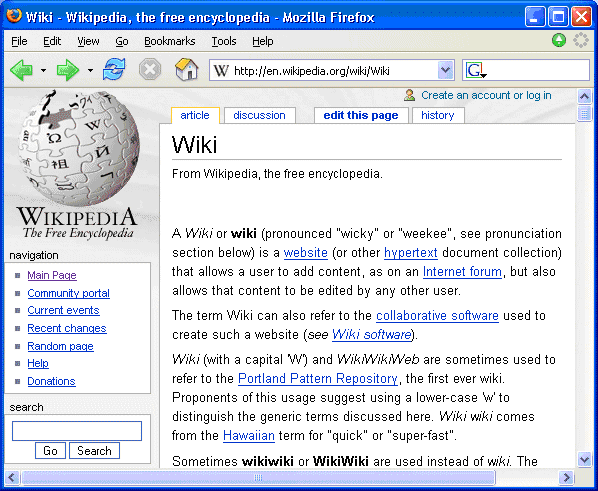
If you’re not somehow familiar with wikis, they are this website/ collaborative platform that allows anyone to create, edit, and link web pages directly from their browser. Funnily enough, the name wiki comes from the Hawaiian word “wiki wiki”, which just means quick. The biggest difference from a regular website that is controlled by a single webmaster, wikis allow the users to collaborate together to populate and edit the contents of the wiki itself. The most famous example is wikipedia, but it’s been used in millions of other places, like your favorite series or video games.
Why Wikis though?
If you want to know the benefits of wiki, there's a lot. Sure, the notes app might work, but the powerful ability of the wiki is to be able to search and click on backlinks of the pages in wiki. You can instantly see the correlation between pages, something that you might've missed if you were using other forms of archiving. It's also worth noting this (mediawiki) is a software that has lived for decades, meaning it has been reiterated and upgraded a lot, it has a lot of extensions ready to be used should you require one. The friction for you to be able to make your own blogs is minimal. Genuinely. If you are somehow compelled to make a wiki after this blog, all you need to do to host one is to simply go to miraheze! It is a very generous provider for wiki. You only need to apply some basic information about your wiki, and voila! But really, mediawiki is perfect for everything. If you're someone who’s just starting in wiki, you don't even need to be good at it per se. All the fancy codes are for usually big wikis, and are only used for maintaining a big wiki. For you and I, there are no needs for complicated modules and such.
There's not much to argue, because this system does work, and it has worked for a long time. The history of wiki and blogging goes hand in hand, no? It's just they both have their respective challenges, so it's no wonder why blogging is more sophisticated. But I'm here to convince you that wiki might just be the best thing you can have for your players, especially in long campaigns. Every small item is recorded there. Your players can see the connections! It's like obsidian, y'know? (I use this app religiously), you can even create a graph view on certain wikis with a special website. Wikis are almost a lost treasure with how prominent AI is. Even if you have an ethical AI that runs locally and the database is just your wiki, it's just not fun. The joy of wiki is to read the contents of a page, slowly and painstakingly, which will end in satisfaction because I know it was written by someone else's blood and sweat. I get to enjoy a curated text that centralizes every data of what I want to find for my character. It's lovely. I don't even need AI, the infrastructure of wiki, which has existed for quite some decades, is already enough to store everything while still being accessible to players but also accessible to contributors (such as GMs ) Support the scene!
PS: Here's my homemade wiki that I made for my friend's campaign. Still very much in progress, but it's really fun, the same fun I made this website.
An attempt to fuse an adventure path with a style of west marches.
I recently had this dilemma, where I want to run the Seasons of Ghosts adventure path in Pathfinder. I've always run homebrew campaigns, so I want to see the flavor of pre-written adventure modules. I was recommended and wanted to run SoG in foundry. So far it looks normal. Turns out...10 of my friends are interested. That's a lot of people. And the problem is, especially in an online setting, it's hard to balance a 10 player party where everyone has their own time to shine. Moreover, if a player can't join a session, we all need to push back the sessions. It's pretty hard. So what do I do to fix this? I still want my friends to all join, and I want them to still experience the fun. So I decided...let me implement some sort of west march element into my campaign.
There's a lot of definitions of west march, but essentially, you can think west march as moreso a sandbox session where players are free to explore or do whatever they desire, and they will depart and return to their home. An episodic, maybe monster of the week format, but aside from the adventure itself, players have a relatively unfixed number. You wanna run with a 10 player party? Go ahead. Maybe only 4 this week? That's okay. Next week, 4 people too, but with different people? That's doable. Another notable feature is in the world of West March, a party's influence may affect another party based on the setting. If the other party had already bought potions, maybe the next party can't buy potions. The world is shared, a collective one. West March is a relatively new concept and it does help to solve some of the modern problems of trying to get a session.
There's still a glaring problem. West Marches are unlike your regular campaign where there's a progressing storyline. Most west-marches don't really care about this progression. It cares more that you're here and you have the modularity to do stuff in the world. Meanwhile, conventional TTRPG campaigns heavily invest in the player’s shared campaign, and it wants the lore to be constructed and synchronized with the rest of the players. When you end a session and continue next time, you are immediately put in the same scene as before. It's deliberately designed to make everyone tied to a single, unified narrative that keeps your party in gripes. How do I exactly make the elements of west-marches still work in a regular trad game?
Here's what I did. I implemented an in-lore explanation for when players "switch schedules". Basically, in my campaign, I split the party down to two parties, and to make sure that everyone can interact with everyone, you as the player are able to choose when / which party to join. Currently, there's 2 parties with 5 people each. I only ask my players to be able to apply and commit to their weekly schedule. I haven't told my players about how exactly they have 2 parties running in conjunction, and how exactly the players suddenly get transported onto another party, but as immersion, they will suddenly glow and teleport to the other party as the in-lore explanation. And yes, this is homebrew, but it's a necessary one. For the finale, I plan to unite everyone, but I'm unsure how to exactly do this. But, that's for another session. Secondly, correlating to the first topic, I constructed a wiki for our campaign. The player's guide is the bible, yes, but with some of my homebrew elements and additional lore, I've decided to construct a wiki to centralize all information. So far, it's been working nice. I wonder if I have any more things I can implement to improve my campaign, but so far I've been pretty content.
The chicken or the egg, the system or the premise?
I don't think of myself as someone that has long dabbled in TTRPGs. Yes, I tried pathfinder for quite some time, but until the start of the year, my only exposure was only PF2E. Starting this year I branched to many other systems, and I'm grateful for that. The problem becomes, how do I even expand from here. And how the hell do I advertise this to my friends?
On one hand, I think everyone plays TTRPGs because of the story that we can immerse into the world itself, which is built by the narrative. Which means, the premise needs to carry the players first and foremost. You need a strong premise, not only to serve as a foolproof foundation of your future stories, but acts as a hook to your players. The genuine limit is your imagination. TTRPGS are like a hotpot of collaboration between people's creativity, so to have an initial narrative that can bind everyone to one, singular horizon is, if not, the biggest homework to do. If this is the case, then we need to find the systems that can accommodate this. Because you can't use any system to every narrative. Some systems are good in certain genres, some aren't.
On the other hand, systems are the sandbox engines that mathematically instructs the players inside to a certain ruleset. The goal? Give you a specific experience. You like being masochistic? Play cyberpunk RED. You want to take it easy? Maybe take OSRs. Systems are specifically designed to accommodate a roleplay session and guide the campaign in their own taste. In trad systems, the dice decides everything, which means your attempt to interact with NPCs (and some PCs), while this one is the opposite. Anyways, there are so many systems and inevitably systems also shape the world, albeit not from an in-world narratively but from a meta-contextual way.
Before I give the grand reveal for the answers, I'll say that almost all systems come with a pre-built world and campaign to some extent. You're already given the initial tools to scoop out your world. You could just build your premise on top of the system's prebuilt lore. In fact I think that's what most people do anyways. Although, there's always the possibility of homebrewing? But the advantages of a TTRPG rulebook is that you've bought this rulebook, and you've been neatly given this rulebook and you can just run conveniently.
The ultimate answer...is that a narrative is built on the constant feedback between players and the GMs. The systems and the premise are tools to achieve this dynamic. The world is alive not only because of the heavy work of the prep of the game that involves tinkering the premise and playing the system's engine, but because the players interact with each other and the world itself. This means...that in an ideal friend group, you can just bring anything up and your group will eat it up anyways. Which...isn't wrong...but that doesn't quite answer the question...
Let's instead change the question. What type of campaign does your group want? And from this, our premise and systems can work in conjunction. Hell, if you want to push yourself, try out systems that are not built for a specific genre of premise, but you end up doing it anyway. Just like my last game, where we tried a noir-themed campaign in a mythic bastionland. Not even electric, but mythic. Which turned out just fine because it's amazing anyways. It's fun to experiment, right? That's the fun of TTRPGs itself.
Comments