This post is a lovely part of the Indonesian Blogwagon!!!!
Overview
Let's talk about Indonesian language, because it is so much impressive than it seems. This language has to account for 17,000 islands, hundreds of ethnic groups, and 700 living local languages (Javanese, Sundanese, Balinese, etc.) Without a thoughtful construction for a lingua franca, people can't communicate with each other. Indonesian was created so that we could talk with our neighbours with ease.
Another fun fact: Due to the reasons above, Indonesian has been made to be learnt easily. What's even cooler is that as an English speaker, you'd actually have an easy time learning this. The U.S. Foreign Service Institute (FSI) makes a benchmark on how much time it will take for it's diplomats to learn foreign languages based on how hard and much time needed for proficiency. Easy languages/first category (takes around 600-750 hours) include French, Spanish, Dutch, while Indonesia sits at around the third category (takes around 900 hours). Not that hard compared to Category V languages like Japanese or Mandarin, which can take up to 2200 hours to be proficient. That's a lot of commitment! But, why is it that Indonesian seems so easy to learn and use? Let's break it down even further.
Features & History
To understand why Indonesian is easy to learn for English speakers, let's see the defining features that shares the same way with English:
- Uses the same latin alphabet. No need to learn new letters like in Mandarin, for example.
- No tones used, like mandarin or Thai, where changing your pitch changes the meaning of a word. Indonesian is non-tonal, so if you speak with a flat English accent people can still generally understand you.
- Words are spelled phonetically, meaning they are spelled exactly like how they sound. There's no invisible rules or silent letters (like the "k" in the English word "knight").
- Grammars are easy. Seriously. No verb conjugations, no gendered nouns, no complex plural rules, and no tenses. There's one defining feature that might be daunting for English speakers, but I found to be a lovely mechanic. It's our unique Affix system! Instead of conjugating verbs, Indonesian relies on a Lego-like system of prefixes and suffixes (me-, -kan, ber-, -i) attached to root words. This can dramatically change a word's meaning, but you can utilize this in fun way! For example, the prefix "me-" is usually the standard one, indicating the verb is on progress (tukar = trade, me + tukar -> menukar = trading). But when you use "ter-" it becomes "an accidental action" (tertukar = accidentally traded). It's really fun playing around the affix system here. Another hurdle is probably that slangs has evolved so much that slangs are it's own language, far, far more varied than English's brainrot.
If you're asking why we have this affix system, it's probably because one of the roots of Indonesian. You see, we are influenced by alot of languages. Yes, Malay is one, but also Arab, Sanskrit, Dutch, Portugese, English, and alot more. But our root language is first and foremost the Austronesian Family. This language family is actually pretty damn wide, From Madagascar all the way to Hawaii and Easter Island. Since the region is dominated by seafaring people spanning alot of region, one of the features that emerged is Agglutination (from a Latin word meaning "to glue together"). Rather than changing the core spelling of a word to show tense or gender (like English run vs. ran, or goose vs. geese), Austronesian languages use a "modular" system. You take a base root word and glue prefixes, suffixes, and infixes onto it to change its function. For a region dominated by maritime trade, this modular system was genius! It allowed merchants across different islands to quickly grasp root words and adapt them on the fly.
Things took a turn when colonialization hits. Back then, when Indonesian wasn't invented, the languages that was mostly used were dependent on each island. Malay wasn't the dominant language back then. However, to solve the intercultural hurdle, a version of Malay was starting to emerge, called Bazaar Malay (Melayu Pasar) Bazaar Malay was a simplified, highly flexible, and grammatically loose version of Malay. It was not prestigious, nor was it used for high literature, but it was incredibly effective for getting business done. It's to be noted that the Dutch were classist pigs; The Dutch government actively discouraged the local masses from learning Dutch. Speaking Dutch was treated as an elite status symbol, strictly reserved for European colonizers, Eurasians, and a very tiny, privileged group of native aristocrats (priyayi) who were allowed into Dutch schools. But how do they manage their local administration, especially when it comes to the local leaders? Malay was easier to teach rather than teach millions to learn dutch. Of course, this eventually backfired. Because the Dutch government relied so heavily on Malay to run their colony, they eventually grew frustrated with the chaotic, rule-breaking nature of Bazaar Malay. This directly triggered the creation of Balai Pustaka in 1917. The Dutch wanted to clean up the language, bypass the messy street dialects, and establish a rigid, standardized "High Malay" for colonial schools and official publications. This is where the formalized versions of the affix system and other grammatical features were standardized.
Eventually when Indonesia reclaim it's Independence, the Indonesian language was shaped once more. Even before that, in the 1920s when the Indonesian Nationalist movement gained momentum, the Youth Leaders wanted to make a change. Standardized "Balai Pustaka Malay" was already spreading through schools and printed media, yet they wanted to do something more. Instead of crafting a completely new language, they took "Balai Pustaka Malay", this structured, affix-heavy version of Malay and rebranded it as Bahasa Indonesia. After independence in 1945, Indonesian language agencies (like the Badan Pengembangan dan Pembinaan Bahasa) took the reins. They continued to polish the affix system, ensuring it was logical, consistent, and capable of handling modern concepts, from science and law to technology, while remaining distinctly Austronesian at its core.
Beauty
It's hard to describe how beautiful a language is when you don't understand the language/to a foreign audience. Luckily, there are certain ways that Indonesian Poets use to elevate Indonesian has the same method like in English. For starters, in English, you might elevate a sentence by using Latin-based words (e.g., saying "lunar" instead of "moon-like"). Indonesian does something similar, but it draws from ancient Sanskrit and classical Malay to create a dedicated literary vocabulary known as bahasa sastra (literary language). When you use these words, you are not just describing an object; you are invoking a specific atmosphere, often tied to nature, longing, or spiritual depth.
Some examples, include:
- Sedih vs Lara : Both represent sadness, but Sedih is the everyday word for feeling sad or upset. Lara, however, is an ache of the soul. It translates closer to "sorrow" or "anguish." When someone experiences lara, it implies a lingering, poetic heartbreak.
- Bulan vs Rembulan : Bulan is the literal, astronomical moon (and also the word for "month"). Rembulan is the moon observed by a poet. It carries the romantic implication of moonlight, nighttime stillness, and beauty.
- Matahari vs Mentari : While Matahari literally means "eye of the day," Mentari evokes the gentle, golden, and comforting light of the early morning sun.
Indonesian allows a writer to paint with two different brushes. You can use the sharp, highly efficient everyday language to move a narrative forward, and then switch to the ancient, echoing words of sastra to make the reader feel the emotional weight of a moment. Examples of these usages aren't tied down to poems, in fact alot of mellow Indonesian songs also employ this technique.
Indonesian as a TTRPG Language
In Indonesia, there's this stereotype that if you are fluent in English and Indonesia and you tend to switch between the two, you are speaking a "JakSel" (Jakarta Selatan/South Jakarta) language, and such is a "Anak JakSel" (Son of the South Jakartans), because South Jakarta is attributed for the young, rich, spirited people hang out in the evening. I feel like an equivalent of this is "Valley girl"? Someone perceived as trendy, affluent, and heavily Western-influenced. While this is becoming more untrue as the years go by due to more and more people being more fluent in both languages, it does cover a special phenomena: You are perceived differently when speaking different languages, and it's not without it's merit. When you speak English and Indonesian, you will probably act differently. This is called codeswitching, a very common occurrence for users of multiple languages. However, this is much more true when it comes to using both English and Indonesian.
In my experience, most of the time I use English to play TTRPGs. I'm sure other Indonesian TTRPGs can attest. But! It goes so much deeper than that. Most of the time, English is the inevitable language of the fantasy world. Most worlds constructed by the systems, they all fit better for English. English is often the language of global pop culture, cinema, and video games, so using English to describe a magical spell or a dramatic betrayal instantly gives the moment a cinematic, elevated weight. What I also experience is that I also use English for my In-Character (IC) voice as well. Why use English in this case? I feel like with this way, players don't necessarily have to put on a silly voice to denote they are acting. The language switch is the act of putting on the character's mask. However, we do use Indonesians at the table, it's just contrast to English. If I use English as the IC voice, then I usually say OOC-ly/metagame using Indonesian. When I ask a question to GM, or to other people, It would resonate with either English or Indonesian. It's for a good reason though, Indonesian is our common language, so it's fair to speak the language meant for casual speaking. Separating the language used when talking in IC and OOC means you can instantly refer to the GM simply by the language itself. This goes reverse too! When a GM asks a question in English, you can be certain that they are asking the character, but if they're asking in Indonesian, they're asking the player. I'm not going to claim this happens 100% all the time, and each player and table is different (some tables has a clear rule on which language to use from the start), but this is what I see more often.
The concept of mashing English and Indonesian together happens alot in TTRPG for other reasons. Some words are just too hard to translate to Indonesian and it's faster to just say the English phrase, then speak the rest in Indonesian. Something like main stats (Dexterity, Will, etc) or, say, Attack of Opportunity, is kinda hard to translate in Formal Indonesian. Even if you do, it loses the charm it has from English, so the English terms act as immutable mathematical constants within an Indonesian sentence structure.
So, while we use both mixture of languages, I think it creates a beautiful symphony. English builds the world, Indonesian grounds the players, and the mixture of both keeps the mechanics running smoothly.
Gameable things
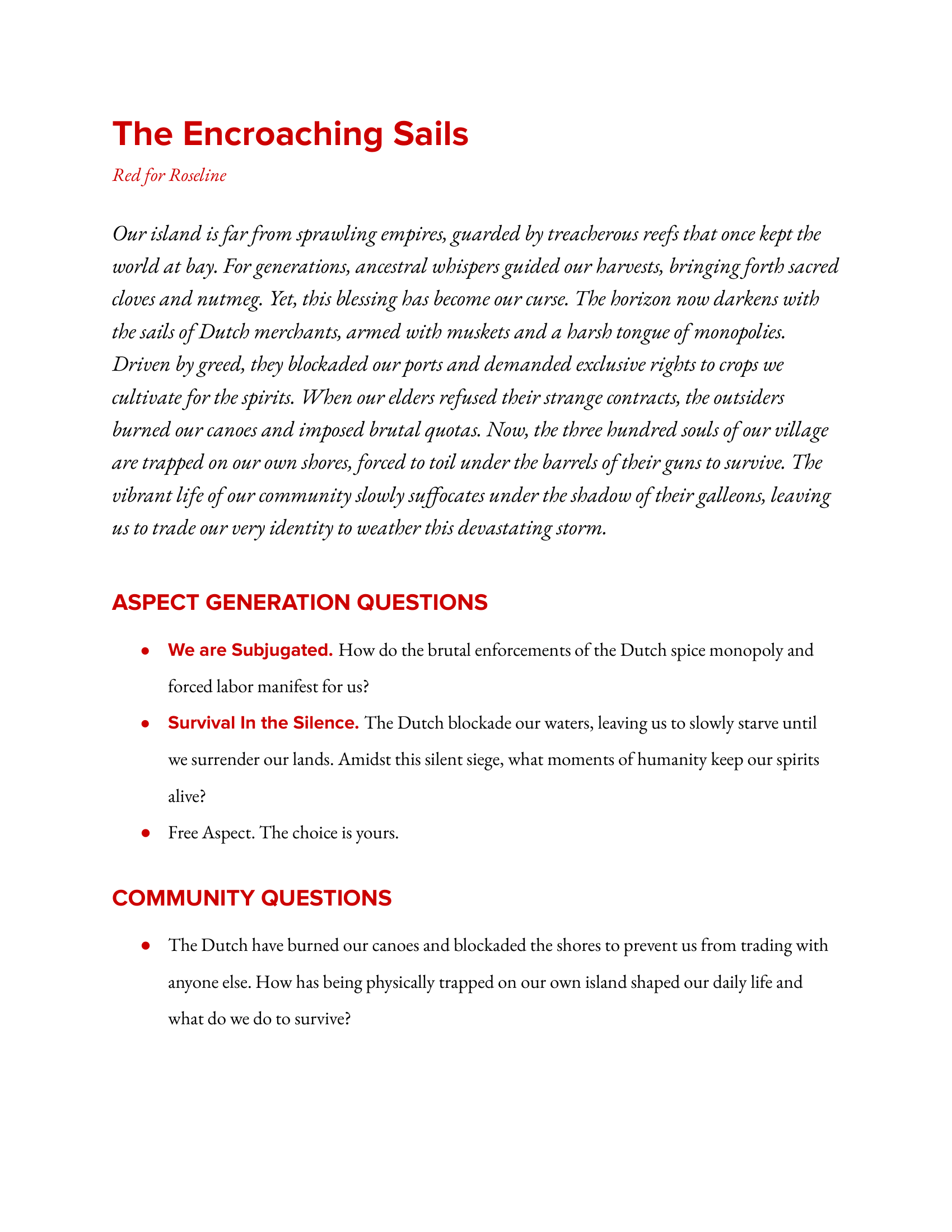
Tables are cool. Unfortunately I suck at making them. I'll be making more to (this isn't my last Indonesian Blogwagon entry), so at the mean time, enjoy this Dialect backdrop! Related to the Indonesian language. You don't have to use Indonesian for this, but I think it can deliver the experience of the Indonesian language getting colonized by the filthy Dutch, or slowly being forgotten as the new urban era draws closer. Have fun!!!
https://files.catbox.moe/telfq2.pdf
Comments